Quickstart#
Reading CHAT data#
First off, we need some CHAT data to work with.
As the CHAT data format is primarily associated with the TalkBank and CHILDES
ecosystem,
it is natural to use one of the available datasets.
A classic dataset is Brown
for American English from CHILDES.
On this webpage, after you’ve logged in (account setup is free),
you should be able to download the full transcripts of CHAT data as a ZIP archive to your local drive.
read_chat() can read this ZIP archive directly:
import rustling
brown = rustling.read_chat("path/to/your/local/Brown.zip")
brown.n_files
# 214
brown.file_paths
# ['Brown/Adam/020304.cha',
#  'Brown/Adam/020318.cha',
#  ...
#  'Brown/Eve/010600a.cha',
#  'Brown/Eve/010600b.cha',
#  ...
#  'Brown/Sarah/020305.cha',
#  'Brown/Sarah/020307.cha',
#  ...]
Brown has 214 .cha data files.
They are organized in subdirectories for the three children of Adam, Eve, and Sarah.
brown is a CHAT instance that represents the Brown data
and provides various methods.
But before we get into those, let’s filter the data down to one of the children,
so that we aren’t producing results with all children’s data mixed up down the road.
With brown in hand, we can filter based on knowledge of the file paths,
targeting those that contain the string "Eve":
eve = brown.filter(files="Eve")
eve.n_files
# 20
eve.file_paths
# ['Brown/Eve/010600a.cha',
#  'Brown/Eve/010600b.cha',
#  'Brown/Eve/010700a.cha',
#  ...]
eve is also a CHAT instance, but with only 20 data files.
Let’s check out some of the data access methods below.
More on Reading CHAT Data.
Header Information#
CHAT transcript files store metadata in the header with lines beginning with @.
Among other things, eve has the age information of Eve when the recordings were made,
which is from 1 year and 6 months old to 2 years and 3 months old:
eve.ages()
# [Age('1;06.00'),
#  Age('1;06.00'),
#  Age('1;07.00'),
#  Age('1;07.00'),
#  Age('1;08.00'),
#  Age('1;09.00'),
#  Age('1;09.00'),
#  Age('1;09.00'),
#  Age('1;10.00'),
#  Age('1;10.00'),
#  Age('1;11.00'),
#  Age('1;11.00'),
#  Age('2;00.00'),
#  Age('2;00.00'),
#  Age('2;01.00'),
#  Age('2;01.00'),
#  Age('2;02.00'),
#  Age('2;02.00'),
#  Age('2;03.00'),
#  Age('2;03.00')]
More on Accessing Headers.
Transcriptions and Annotations#
words() is one of the methods to access the transcriptions:
words = eve.words()  # list of strings, for all the words across all 20 files
len(words)  # total word count
# 120317
words[:8]
# ['more', 'cookie', '.', 'you', 'more', 'cookies', '?', 'how_about']
By default, words()
returns a flat list of results from all the files.
If we are interested in the results for individual files,
the method has the optional boolean parameter by_file:
words_by_files = eve.words(by_file=True)  # list of lists of strings, each inner list for one file
len(words_by_files)  # expects 20 -- that's the number of files of ``eve``
# 20
for words_one_file in words_by_files:
    print(len(words_one_file))

# 5833
# 5272
# 2500
# 5765
# 5742
# 4355
# 5352
# 8934
# 4474
# 4573
# 4207
# 6218
# 4459
# 5240
# 8109
# 7378
# 10910
# 8427
# 6931
# 5638
Apart from transcriptions, CHAT data has rich annotations for linguistic
and extra-linguistic information.
Specifically, many CHAT datasets on CHILDES have the %mor and %gra tiers
for morphological information and grammatical relations, respectively.
A CHAT data object such as eve from above has all this information readily available
to you via tokens()
– think of tokens()
as words() with annotations:
some_tokens = eve.tokens()[:5]
some_tokens
# [Token(word='more', pos='adj', mor='more-Cmp-S1', gra=Gra(dep=1, head=2, rel='AMOD')),
#  Token(word='cookie', pos='noun', mor='cookie', gra=Gra(dep=2, head=2, rel='ROOT')),
#  Token(word='.', pos='', mor='.', gra=Gra(dep=3, head=2, rel='PUNCT')),
#  Token(word='you', pos='pron', mor='you-Prs-Acc-S2', gra=Gra(dep=1, head=3, rel='NSUBJ')),
#  Token(word='more', pos='adj', mor='more-Cmp-S1', gra=Gra(dep=2, head=3, rel='AMOD'))]

# The Token class is a dataclass. A Token instance has attributes as shown above.
for token in some_tokens:
    print(token.word, token.pos)

# more adj
# cookie noun
# .
# you pron
# more adj
Beyond the %mor and %gra tiers,
an utterance has yet more information from the original CHAT data file.
If you need information such as the unsegmented transcription, time marks,
or any unparsed tiers, utterances() is what you need:
utterance = eve.utterances()[0]
utterance
# Utterance(participant='CHI', tokens=[...3 tokens], time_marks=None)
utterance.tiers  # original, unparsed tiers for annotations etc.
# {'CHI': 'more cookie . [+ IMP]',
#  '%gra': '1|2|AMOD 2|2|ROOT 3|2|PUNCT',
#  '%mor': 'adj|more-Cmp-S1 noun|cookie .',
#  '%int': 'distinctive , loud'}
As we’ve started digging into the data, it would be helpful to distinguish
the child speech (i.e., participant = “CHI”) versus child-directed speech.
Use filter() to filter eve down to the desired subset
of the data:
eve_chi = eve.filter(participants="CHI")  # child speech
eve_chi.utterances()[:5]
# [Utterance(participant='CHI', tokens=[...3 tokens], time_marks=None),
#  Utterance(participant='CHI', tokens=[...3 tokens], time_marks=None),
#  Utterance(participant='CHI', tokens=[...3 tokens], time_marks=None),
#  Utterance(participant='CHI', tokens=[...2 tokens], time_marks=None),
#  Utterance(participant='CHI', tokens=[...2 tokens], time_marks=None)]

eve_cds = eve.filter(participants="^(?!CHI$)")  # child-directed speech, regex ^(?!CHI$) for "not CHI"
eve_cds.utterances()[:5]
# [Utterance(participant='MOT', tokens=[...4 tokens], time_marks=None),
#  Utterance(participant='MOT', tokens=[...5 tokens], time_marks=None),
#  Utterance(participant='MOT', tokens=[...7 tokens], time_marks=None),
#  Utterance(participant='MOT', tokens=[...2 tokens], time_marks=None),
#  Utterance(participant='MOT', tokens=[...4 tokens], time_marks=None)]
More on Transcriptions and Annotations.
Word Frequencies and Ngrams#
For word combinatorics, check out word_ngrams().
A special case of general interest is word frequencies,
which are unigrams (ngrams with n = 1):
word_unigrams_chi = eve_chi.word_ngrams(1)
type(word_unigrams_chi)
# Ngrams  # stores ngrams efficiently, otherwise works like a collections.Counter
word_counter_chi = word_unigrams_chi.to_counter()
type(word_counter_chi)
# collections.Counter  # https://docs.python.org/3/library/collections.html#collections.Counter
word_counter_chi.most_common(10)
# [(('.',), 10389),
#  (('?',), 1449),
#  (('I',), 1197),
#  (('that',), 1047),
#  (('a',), 883),
#  (('it',), 799),
#  (('Fraser',), 682),
#  (('you',), 636),
#  (('the',), 558),
#  (('my',), 519)]

word_counter_cds = eve_cds.word_ngrams(1).to_counter()
word_counter_cds.most_common(10)
# [(('.',), 9682),
#  (('?',), 4909),
#  (('you',), 3080),
#  ((',',), 2090),
#  (('the',), 1966),
#  (('it',), 1565),
#  (('what',), 1550),
#  (('a',), 1324),
#  (('I',), 899),
#  (('is',), 894)]
Note that ngrams are represented as Python tuples, which is also true for unigrams as shown. This short illustration already shows some of the characteristic differences between child speech and child-directed speech, e.g., more questions and second-person pronouns in child-directed speech than child speech.
To check out the top word bigrams:
eve_chi.word_ngrams(2).to_counter().most_common(5)
# [(('it', '.'), 356),
#  (('that', '?'), 326),
#  (('yeah', '.'), 326),
#  (('no', '.'), 296),
#  (('there', '.'), 253)]

eve_cds.word_ngrams(2).to_counter().most_common(5)
# [(('what', '?'), 503),
#  (('it', '.'), 347),
#  (('on', 'the'), 327),
#  (('are', 'you'), 308),
#  (('in', 'the'), 301)]
More on Word Frequencies and Ngrams.
Developmental Measures#
To get the mean length of utterance (MLU), use mlu():
eve_chi.mlu()  # mean length of utterance in morphemes
# [1.43,
#  1.82,
#  2.15,
#  2.07,
#  2.16,
#  2.4,
#  2.43,
#  2.4,
#  2.86,
#  2.72,
#  2.69,
#  3.4,
#  3.5,
#  2.83,
#  3.54,
#  3.24,
#  3.61,
#  3.2,
#  3.8,
#  2.24]
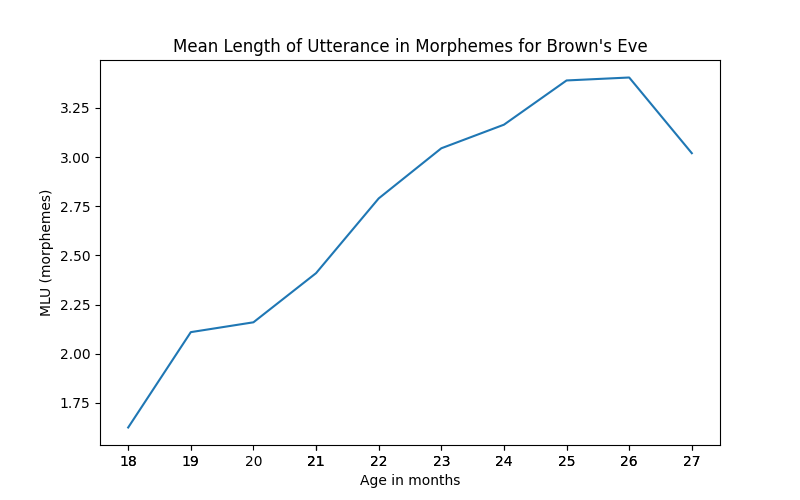
The result is the MLU in morphemes for each of Eve’s CHAT files in order. As this is a list of floats, they can be readily piped into code for making plots, for example:
import rustling

# matplotlib and seaborn required for this code snippet
import matplotlib.pyplot as plt
import seaborn as sns

brown = rustling.read_chat("path/to/your/local/Brown.zip")
eve = brown.filter(files="Eve")
eve_chi = eve.filter(participants="CHI")
ages_in_months = [age.in_months() if age else None for age in eve_chi.ages()]

plt.figure(figsize=(8, 5))
sns.lineplot(
    x=ages_in_months,
    y=eve_chi.mlum(),
    errorbar=None,
)

plt.title("Mean Length of Utterance in Morphemes for Brown's Eve")
plt.xlabel("Age in months")
plt.ylabel("MLU (morphemes)")
plt.xticks(ages_in_months)

plt.savefig("brown_eve_mlum.png")
plt.close()
More on Developmental Measures.
Questions?#
If you have any questions, comments, bug reports etc, please open issues at the GitHub repository, or contact Jackson L. Lee.